Ring ligament injuries
Ring ligament injuries are the most common finger injury among climbers. The ring ligament reinforces the flexor tendons on the inside of the fingers. Its function is to hold the tendons in place against the bone.
Causes
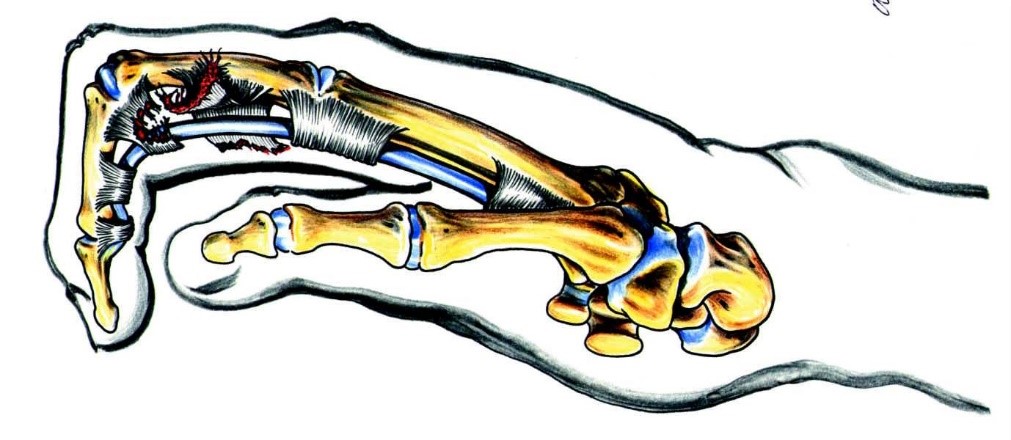
Ankle ligament injuries most often occur acutely, resulting from a combination of the crimp grip (see image) and a sudden increase in weight (most commonly when a climber loses their footing while climbing). However, the ring ligament has often been subjected to wear and tear prior to an acute injury, which may have weakened the ligament and thus increased the risk of it tearing completely.
Symptoms
The symptoms of a ring ligament injury are pain, tenderness, and swelling on the flexor side of the finger.
Diagnosis
The diagnosis is based on the history of the injury and a clinical examination. The athlete experiences pain when pressure is applied to the ring ligament, especially if the athlete bends the finger at the same time. In severe cases, where multiple ring ligaments are injured simultaneously, the flexor tendon may feel like a thick cord (bowstring) under the skin. An ultrasound examination should be used to assess the severity of the injury. This determines when the athlete can resume training.
Treatment
If only one ring ligament is injured or torn, the injury is treated without surgery. This involves immobilization with tape or a splint for two weeks, followed by rehabilitation of the flexor muscles and a gradual increase in load toward sport-specific training. It is recommended to use protective tape on the finger during rehabilitation and when resuming sports activities. If multiple ring ligaments are torn, the athlete should undergo surgery.
Prognosis
The prognosis following a ring ligament injury is good, but recovery may take some time. After a ring ligament tear, the athlete can expect to regain full strength and reach the same climbing level as before one year after the injury.